Article
The One-on-One That Pays You Back
A new team lead. A quiet thirty-minute meeting. A surprise resignation six weeks later. This article unpacks the small structure that turns dead-air one-on-ones into the most useful conversation of your week — for both manager and team member.

- Published on
1. The Meeting That Goes Nowhere
Maya is a new team lead (the manager of a small team). She has six people. She's been doing the job for four months and is still figuring it out. Every Tuesday at 10:30, she has a thirty-minute one-on-one (a regular private chat between a manager and one team member) with Sam.
Today is Tuesday. Here is the meeting.
Maya: How's it going? Sam: Yeah, fine. All good. Maya: Anything blocking you? Sam: Nope. On track. (Silence for eight seconds.) Maya: Cool. I think we're done early then. Sam: Sounds good.
They end ten minutes early. Both feel quiet relief. The meeting was, in some sense, fine. Nothing broke.
Six weeks later, Sam quits.
The exit interview (a short meeting when someone leaves a job, to learn why) tells Maya what she missed. Sam had been ready to leave for two months. The signal had been there. A slow design handoff. A senior peer who kept rewriting their code. A growing sense that their work was invisible. None of it showed up in the project plan. None of it would have. That kind of thing only shows up in a one-on-one. But only if the one-on-one is doing real work.
Maya's "fine, all good" meeting was not doing real work. It was a status check with awkward silence. Sam learned, week by week, that there was no point bringing anything heavy. So they stopped trying.
This is the most common one-on-one in the world. Most managers run it. Most direct reports (the people a manager is responsible for) sit through it. Both sides feel something is missing. Neither side knows the fix.
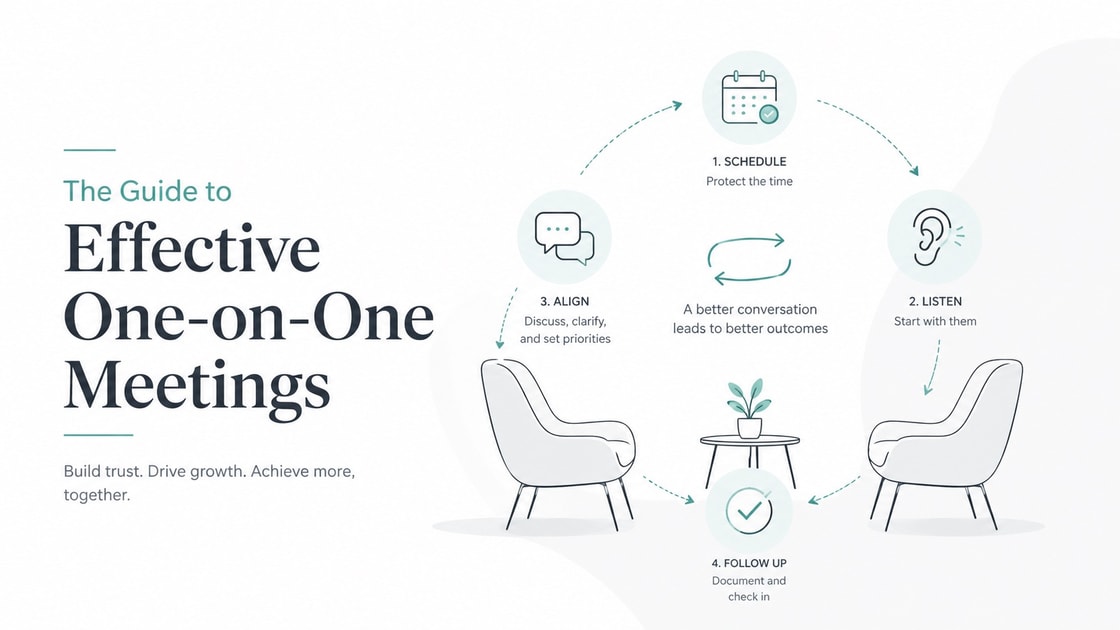
There's a small structure that turns this dead air into the most useful thirty minutes of your week — for both of you.
That's what this article is about.
Both meetings cost you the same thirty minutes. One pays you back. The other one does not.
2. What a One-on-One Actually Is (and Isn't)
A one-on-one is a regular, private conversation between a manager (the person responsible for someone's work and growth) and a direct report (the person they manage). Most teams hold it for thirty minutes, every week or every two weeks. The cadence (how often you meet) matters less than the fact that the meeting actually happens.
The meeting has a small set of jobs. Build trust. Hear what the team member cannot say in a group. Spot problems early. Help the person grow. Give the manager a clear picture of the team that no dashboard can match.
Here is what the meeting is not. It is not a status update (a meeting where you list tasks and progress). Status belongs in a written note, a task tool, or a short daily team check-in. Not here.
This point is worth saying once, and saying it hard. If the entire thirty minutes is "what did you do, what's next, any blockers," you have wasted the slot. A blocker (something that stops you from finishing a task) is something you can list in two lines. Status fits in five lines on a shared doc. The one-on-one is for the things that don't fit in a ticket. How the person feels about their work. What they are stuck on as a human. What they think about the team. What they want next year.
Here's a quick contrast.
| Status update | One-on-one | |
|---|---|---|
| Purpose | Track tasks | Build trust, spot signal, grow the person |
| Who talks more | The person doing the work | The team member, by a clear margin |
| What good looks like | Clear progress, clear blockers | Honest answer to "how are you?" |
| What bad looks like | Vague, off-track, missing | "Fine, on track. All good." |
Maya's first one-on-one with Sam went 25 minutes about technical tickets. Three weeks later she still didn't know what Sam was actually worried about. The meeting had been a status update with extra steps.
What does the manager get back from running it the right way? Early warning. Project plans tell you what was supposed to happen. A daily team check-in tells you what is on track today. The one-on-one is the only place where you hear what is actually happening. It's what the team member feels but won't say in front of the group. That is the cheapest, most honest information channel you will ever have.
3. The Four-Question Frame — Your Default Structure
Most one-on-ones don't need a script. They need a frame. Here is one that holds up across teams, cultures, and topics.
Four questions, in order:
- How are you?
- How are things going?
- What are you going to do next?
- Is there anything I can do to help?
That's it. Use it as the spine of the meeting. Skip a question when it doesn't fit. Stay on one question the whole time when you need to.
How are you?
Not the polite version. The real one. Ask, then pause. Let the silence sit.
This question signals that you see the person, not their task list. If they answer about life — a sick parent, a tough commute, a child not sleeping — stay there. Don't rush back to work.
Maya: How are you? Sam: Honestly? Tired. My daughter's been up at 4am all week. Maya: Oof. Anything I should know about for the rest of the week? Sam: I might shift my deep-focus time to the mornings. Afternoons are rough. Maya: Do that. Block your calendar. I'll cover the 3pm sync.
What you get back: an early read on a person. A tired team member who feels seen will tell you they are tired before they burn out. A tired team member who hides it will hand in their notice in eight weeks. The first kind costs you a fifteen-minute calendar shuffle. The second kind costs you a hire.
How are things going?
Now you move toward work. But still open. Don't ask about a specific project. Let them choose what to bring up.
What they choose is the signal. Listen for it.
Maya: How are things going? Sam: Mostly good. The new feature is moving. Design handoffs feel slow though. Maya: How slow? Sam: Two days each. Sometimes more. It's fine, I work around it. Maya: Tell me more about the work-around. That sounds like it adds up.
What you get back: friction, six weeks before it shows up in the project plan. Sam said "it's fine" and then described the exact thing that will slip the launch. You only heard it because the question was open.
What are you going to do next?
The pivot from talking to action. This is also where managers most often go wrong.
When a team member brings you a problem, do not solve it for them. Help them find the next step they can take themselves. There is an old phrase for this: don't take the monkey on the desk. The phrase means: don't let the team member leave the problem with you. The point is simple. People grow by solving their problems, not by handing them off.
Sam: I don't know what to do about the design delays. Maya: What's one step you could take this week, not me? Sam: I could ask the design lead for a shared queue. Maya: Good. Try that. Tell me how it lands next Tuesday.
What you get back: a team that grows. And a calendar that isn't full of other people's problems.
Is there anything I can do to help?
The closer. Often the answer is "no." Sometimes it is something only you can do. Talk to a peer manager. Shield the person from a meeting. Push back on scope (the agreed limits of what a project will deliver).
This is where you earn trust. Whatever you commit to here, do it. One broken promise here costs you ten meetings of trust.
Maya: Anything I can do to help? Sam: Could you talk to the design lead too? Coming from you, the queue idea will land harder. Maya: Sure. I'll message them today and copy you. Sam: Thanks. I'll send a short draft of the queue idea this afternoon, so you have it.
What you get back: the trust that lets the next hard conversation land. People remember the one promise you kept. They remember it more than the ten conversations you had.
A trade-off note: this frame is a default, not a cage. Some weeks the whole meeting is question one. Some weeks you skip three of the four. The frame is a safety net for the empty meeting. It is not a script for the full one.
4. The Five Pitfalls That Kill One-on-Ones
Every manager falls into at least two of these. The job is to notice them and stop.
1. Running it as a status update. You spend thirty minutes on tickets, deadlines, and "what's next on Project X." The person leaves with nothing they couldn't have written in a chat message. This was Maya's first one-on-one with Sam. Twenty-five minutes on tickets, zero minutes on the things that mattered. Fix: move status to a tool or a written update. Use the meeting for the things that don't fit a ticket. How they feel. What they're stuck on. What they want next.
2. Treating the meeting as optional. You cancel when you're busy. You reschedule "to next week" three weeks in a row. The signal lands clearly: you don't matter. Fix: when you can't make it, reschedule, don't cancel. A moved meeting says "still important." A canceled meeting says the opposite.
3. Talking more than listening. Managers love to direct. The one-on-one is the one place where you should not. If you are talking, you are not learning anything. Fix: aim for 70% them, 30% you. Try counting it once. The result will surprise you. Then count again next month.
4. Walking in with no plan. "It'll just flow" is the manager's most expensive lie. With no agenda (a short list of things you plan to talk about), the meeting either stays surface-level or wanders. Fix: a five-minute prep. A three-line shared agenda. Either side can add to it during the week. Even a single bullet — "design handoff delays, follow up" — turns a vague meeting into a useful one.
5. Forgetting to follow up. You agreed in last week's meeting that you'd talk to the design lead. You didn't. The team member noticed. They will not raise it again. Fix: at the end of every meeting, write down two things. What you'll do. What they'll do. Send a one-line message after. Action items (small, named tasks with one owner each) are the difference between a meeting and a conversation.
Honest count: if you have run one-on-ones for a year, you have done at least three of these five. Probably this week. The fix is not to feel bad. The fix is to notice the pattern in your own meetings and adjust the next one.
What you get back from avoiding these: the meeting starts to do its job. You hear real things. You get information you can act on. The team member stops waiting for the meeting to end. They start bringing something to it.
5. How to Make Every One-on-One Give Back to You
You came to this article partly because you want the one-on-one to also help you. Not only your team member. That's fine. There is nothing wrong with wanting better information, calmer projects, and a team that trusts you. A meeting that only flows one way collapses anyway. The good ones are an exchange.
Here is what a well-run one-on-one gives the manager. Each gain is paired with the specific habit that produces it.
Early signals you can act on. When you ask "how are things going?" and listen, you hear friction six weeks before it hits the project plan. Sam mentioned the slow design handoffs in passing. Maya followed up with the design lead. Two months later, that would have been the slipped launch. Instead it became a small fix to a queue. The habit: the open question, plus the patience to follow up on the small comment that sounded like nothing.
Honest feedback you can't get anywhere else. End some one-on-ones with a single question: "What is one thing I could do differently to support you?" Most people will say "nothing" the first three times. That is normal. Then, one day, they will tell you. That single sentence has saved more careers than any formal review. The habit: ask, accept the silence, ask again next month.
Information for managing up (passing useful signal back to your own boss and to senior people). Patterns across your one-on-ones tell you what the team needs from your boss, your peers, and the wider organization. Three people mention the same blocker? You walk into your own one-on-one with your manager carrying real signal, not opinions. The habit: keep notes (a shared doc per direct report works fine) and re-read them before your own one-on-one.
A calmer week. A team member who feels heard does not need to escalate to your boss to be heard. The skip-level (a meeting between your team member and your own manager, skipping you) email becomes rare. Escalation (taking a problem above the normal chain to push it forward) becomes a tool, not a habit. The habit: question four — "is there anything I can do to help?" — and then doing the thing.
Trust that lets hard conversations land. One day you will need to give hard feedback (specific comments about a person's work, what's working and what isn't). Maybe a missed deadline. Maybe a "needs improvement" rating. The relationship you built in fifty smaller one-on-ones is what carries that conversation. Without it, the feedback bounces off. With it, the person hears you. The habit: do the small one-on-ones well every week, when you don't need them yet.
A note on cost. This is real work. Thirty minutes per person, per week, plus prep and follow-up. For a team of six, that is four to five hours of your calendar. It is a real cost. It is also the four most useful hours you spend that week. Defend the time the way you'd defend a launch date. Firmly. With a calendar block that does not move for anything less than a fire.
One last thing. If you find your one-on-ones drifting back into status, say it out loud. "I notice we keep slipping into status. Let's keep status in the doc and use this time for the harder stuff." Most team members will be relieved. You won't be the only one tired of the awkward version.
6. Hard Conversations — Performance Feedback Without the Sandwich
The hardest part of one-on-ones is not the weekly check-in. It is the day you have to deliver feedback that is going to sting.
First, kill the sandwich.
The feedback sandwich (positive comment, then critical comment, then positive comment) is bad. Most readers have had it used on them. After two of them, you see the pattern coming. The bread becomes a warning sign. "Here comes the thing you actually wanted to say." It hides the message you came to deliver. It also teaches the team to discount the positive parts. Don't use it.
Use the after-action review (AAR) instead. It is three questions:
- What was supposed to happen?
- What actually happened?
- What are we learning from this?
The frame comes from teams that debrief hard events — the military, emergency rooms, incident response. The point of it is that it takes the heat out. You are not telling the person they failed. You are walking through what happened, together.
Compare the two versions.
Maya (bad): Sam, you really need to be more proactive. The doc was late, and that's not the first time. Sam: (defends, freezes, or shuts down)
Now with AAR:
Maya: We agreed the client doc would land Tuesday. It came in Friday. Walk me through what happened. Sam: The legal review took three days longer than I planned. I should have flagged it on Tuesday morning when I saw the slip. Maya: What can we change so it doesn't repeat? Sam: I'll add a Tuesday check-in on every doc that needs legal. I'll flag any slip the day I see it. Maya: Good. Let's add that to the template too.
Read both aloud. The temperature drops. There is no defense to mount because no one is being attacked. There is a problem on the table and two people looking at it together.
What you get back from this approach: faster fixes, fewer defensive arguments, and a team that brings problems early. They bring them early because they trust the conversation.
A note on the performance review (the formal evaluation of a person's work, usually once or twice a year). It is a different shape, but the same skills apply. Most reviews land in one of two places. Meets expectations (doing the job at the level expected) is the common one — most people, most of the time. Does not meet expectations (the person is not yet at the expected level) is rarer and harder.
The cardinal rule of performance reviews: nothing in the review should be new information. If a team member first hears about a missed deadline at their annual review, you failed the weekly one-on-ones. The review should be a summary of conversations they already had. Not a surprise.
When you are on the receiving side of a hard review, three small habits help. Don't defend in the moment — repeat back what you heard, in your own words. Ask one clarifying question. Ask one example. Then process it on your own time. The conversation later, where you make a plan to improve, is a separate conversation.
What the manager gets back from doing this well: fewer grievances, fewer surprise resignations, faster fixes when something is off. And feedback that actually lands. It lands because you've been giving small, clear pieces of it every week.
7. When You're the One Sitting in the One-on-One
Not every reader runs one-on-ones. Some sit in them. The good news: you can run the meeting from your side too.
Bring a short agenda. Even three lines. What you want to cover. What decision you want out of the meeting. Anything you'd like feedback on.
Decide ahead what you want. A decision? Support on a blocker? Feedback on a piece of work? Exposure to a senior person? Naming the goal turns a vague meeting into a useful one.
A senior person asking for a one-on-one is not always bad. New project managers and engineers panic when a VP (vice president, a senior leader several levels above you) suddenly drops a meeting on the calendar. Don't. Ask, before the meeting, in plain language: "Could you share what you'd like to cover, so I can prepare?" Most senior people will tell you. Then walk in with the documents you actually need.
Receiving feedback is a skill. When you hear "you meet expectations, but here is where to grow," resist the urge to defend. Replay back what you heard. Ask one clarifying question. Ask for one example. Ask what the next level looks like. Process the harder parts later, on your own time. Don't try to argue in the moment. You will lose either way.
You are allowed to ask for things. A clearer goal. More time on a project that grows you. Less of the work that doesn't. Help with a specific blocker. Exposure to a senior person whose support you want. The one-on-one is the right place to ask. If you don't ask, you don't get.
Real situation. Sam's VP, Priya, scheduled a same-day one-on-one with no agenda. Sam's first instinct was panic — "what did I do wrong?" Their second instinct, after reading this article, was to message Priya. The message: "Happy to meet at 4pm — could you share the topic so I can prepare?" Priya replied: budget question on Project X. Sam walked in with the project charter and the latest spend numbers. The meeting was five minutes. Priya looked relieved. Sam looked competent. Both were true.
What you get back from running it well from your side: better answers and fewer surprises. The senior person starts to think of you as someone who comes prepared. That's worth more than a year of polite check-ins.
8. Closing Takeaways
- The one-on-one is not a status meeting. Status goes in a tool. The meeting is for the things that don't fit a ticket.
- Four questions handle most conversations. How are you? How are things going? What's next? How can I help? Ask them in that order. Leave real silence between them.
- Listen more than you talk. Aim for 70% them, 30% you. Count it once.
- Don't take the problem home. Help them find the one next step they can take themselves.
- No feedback sandwich. Use the AAR frame for hard conversations: what was supposed to happen, what actually happened, what are we learning.
- Follow up. The meeting only counts if something happens after it. Two action items. One short note.
- Done well, this is the cheapest, most honest information channel you will ever have. For both the manager and the team member.
The first one-on-one you run with this frame will feel awkward. So will the second. By the fourth, the silence is no longer awkward. It is where the real answers come from. Run it well for a year. Most of the surprises that used to land on your desk will arrive much earlier — when they are still small.
That is the whole job, really.